When the Grand Tour Became a Traveler’s Education
The Grand Tour linked travel with cultural learning. Explore its legacy and plan a thoughtful visit that centers local voices, personal questions, and time to reflect.
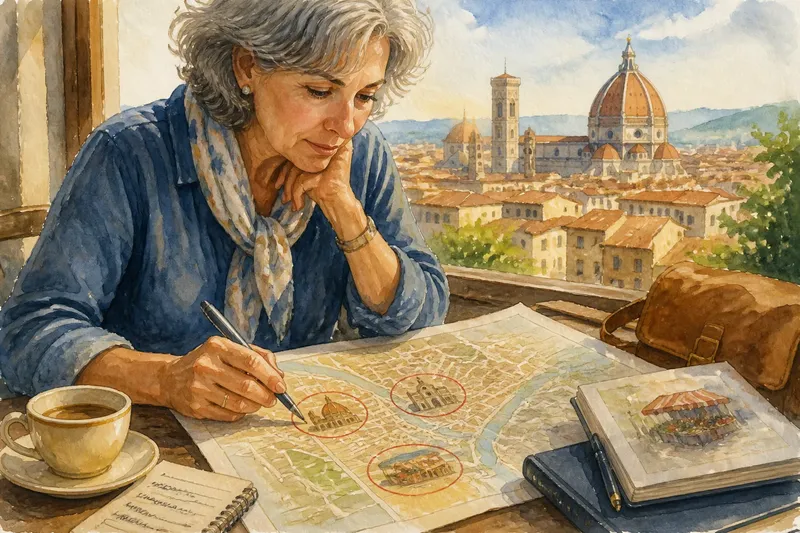
At a station café, Elaine opens a map of Florence and circles a gallery, a church, and a market. The Grand Tour comes to mind: travel framed as a way to learn. She wonders how to take that idea seriously without treating cultural sites like lessons to complete.
Imagine Elaine is a fictional traveler planning a week in Florence. She enjoys paintings, but long museum visits tire her. She wants to understand something about the city, not race between its most famous attractions. Her question is simple: what could travel teach if the itinerary left room for curiosity, local knowledge, and rest?
The Grand Tour idea
The Grand Tour is commonly associated with extended European journeys by young men from wealthy families, sometimes accompanied by tutors or other companions. Travelers might visit places valued for art, ancient sites, architecture, and social connections. Access was limited by wealth and social position, and the route and purpose varied from traveler to traveler.
Travel could be understood as education beyond formal lessons. A visitor might observe customs, encounter different languages, and develop ideas about art and society. That did not make every traveler an expert, or every encounter an equal exchange. The people who lived in visited places had their own knowledge and priorities, whether or not visitors recognized them.
For Elaine, the useful question is not whether she can recreate an old itinerary. It is how to learn without assuming that a brief visit gives her authority over a place. She wants to listen, notice, and remain open to what she does not understand.
One question, many settings
Elaine first sketches a crowded day: a major gallery in the morning, a celebrated church after lunch, and another landmark before dinner. She chose each stop because it seemed essential. Looking at the schedule, she sees little time to connect what she encounters or simply sit down.
She changes her plan around one question: who makes, cares for, and explains the things visitors admire? A painting might lead her to consider its frame and display. A church might prompt her to notice signs of present-day use. A craft stall might introduce a material or technique, if the seller is willing to talk.
She keeps the gallery and church, but checks their current visitor information before going. She chooses one area that interests her in each place and leaves open time for a market or a rest. That is enough structure to give the week a thread without requiring every stop to produce a lesson.
Reading a place carefully
In the gallery, Elaine spends time with one painting. She reads its label, notices how it is displayed, and writes down a question the label does not answer. If the museum offers an audio guide or a public tour, she can use it for added context without treating it as the only interpretation.
At the church, she looks beyond the feature most often photographed. A notice about services, a quiet area, or information about the building’s care can suggest that the site has a life beyond tourism. These details do not make her an authority on religious practice. They help her remember that a historic building may also matter to a community today.
At the market, Elaine does not expect a vendor to explain local culture. If the moment feels appropriate, she can ask a brief question about a product or material and accept a short answer, a change of subject, or no conversation. A public demonstration, shop label, local guide, or cultural organization may offer other sources of information.
After each outing, she notes one detail in a small notebook: something she might forget, a question to look up, or a connection between two places. She does not try to record everything. The point is to carry a thought forward, not to grade herself on what she remembers.
Plan for a slower pace
A useful plan can make cultural visits easier without turning them into a checklist. Elaine considers each stop in terms of energy, interest, and the kind of context she can access.
- Check the venue’s current visitor information; if hours or access details are unclear, confirm them through an official channel before setting out.
- Choose one gallery, room, or feature to focus on; if it still interests you, stay with it, and if it does not, move on without trying to cover the whole site.
- Look for labels, audio guides, public tours, or posted explanations; if one source feels incomplete, seek another rather than treating it as the final word.
- Notice whether a place is used by a local community as well as visitors; if signs indicate an active religious or civic setting, follow its posted guidance and choose another area if access is limited.
- Ask a seller or guide a concise, relevant question only when conversation seems welcome; if they are busy or decline, let the exchange end and use a public source instead.
- Leave open time for a meal, rest, or return visit; if fatigue builds, drop an optional stop and keep the visit that matters most to you.
It is not worth the effort to collect a note from every room or force a conversation just to make a trip feel educational. A small number of attentive encounters can leave more to think about than a packed schedule.
Questions about the Grand Tour?
What was the Grand Tour?
It refers to extended European travel associated especially with wealthy young men and exposure to art, ancient sites, languages, and social life. Its routes and purposes varied, and access was unequal.
Why did families value the journey?
Travel could be treated as a way to gain knowledge, social experience, and judgment beyond formal study. What a particular traveler was expected to learn depended on that person’s circumstances and the journey’s purpose.
Does the Grand Tour shape travel today?
Its cultural image can encourage visitors to think that a worthwhile trip requires famous sights and a prescribed course of learning. A traveler can question that expectation by choosing a personal subject to follow rather than trying to complete a canon.
How can visitors respect local knowledge?
Use more than one source, ask questions only when an exchange is welcome, and avoid treating a brief encounter as a complete account of a community. If a place’s rules or meaning are unclear, consult its official information or a qualified local guide.
Carry a question home
Say Elaine has an afternoon free after a gallery visit and a market stop. Her starting point is a question about who makes and cares for admired objects. She writes down a frame detail from the gallery, reads a public description of a craft at the market, and asks a seller about the material only when the seller is unoccupied. The seller gives a brief answer and returns to work. Elaine’s resulting note connects the frame and the material, while making clear that one short exchange cannot explain a whole craft tradition.
That is the kind of learning Elaine wants: specific enough to remember, modest about what it can claim, and open to more context later. The Grand Tour can prompt a question about travel and education, but Elaine’s own question gives her week its direction. Near the end of her notes, she writes the phrase “Grand Tour” beside a reminder to look for local accounts of the places she enjoyed.
Before heading home, she returns to one spot she liked. She sits, looks again, and lets the visit end without searching for another attraction. A thoughtful itinerary can leave room not only for discovery, but for a comfortable pause that helps an experience settle.