Rail, Road or Sea: The Feel of a Slow Journey
Compare a slow journey by rail, road, or ferry through scenery, rhythm, and attention, then choose the kind of travel that suits how you want to feel.
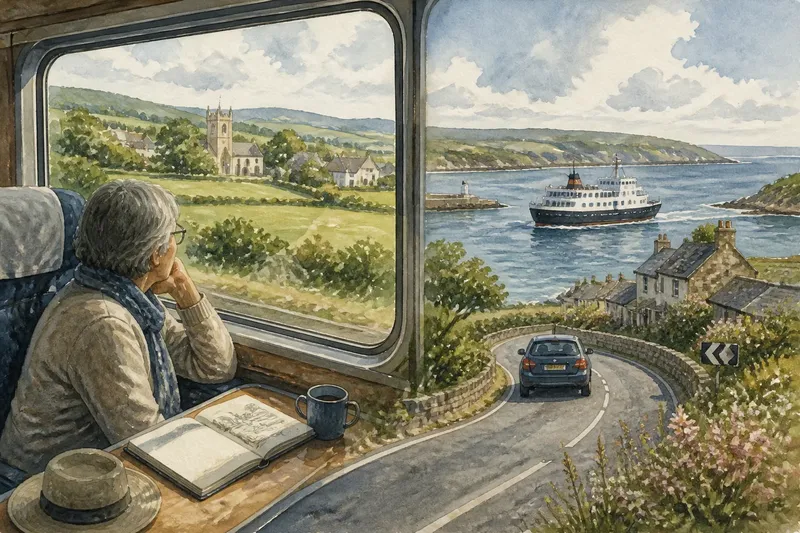
A train window frames fields in passing strips; a road bends toward a village; a ferry leaves a harbor slowly enough for its shape to linger. A slow journey by rail, road, or sea is not simply a choice of vehicle. Each way of traveling gives your attention a different job, and that can shape how a place stays with you.
For an older traveler, the useful question is not which mode is best in the abstract. Ask what you want to notice, how much change of scene feels welcome, and whether you would rather watch, steer, or settle in. The distinctions below can help you choose a journey for its character, not its speed or cost.
1. Rail Makes a Moving Panorama
Rail travel offers a continuous view with little need to manage it. The landscape arrives in broad sequences: allotments and back gardens near a town, then open farmland, hills, river crossings, and the next cluster of rooftops. A train window can make transitions visible without asking you to plan each one.
The rhythm is set by the line and its stops. A station brings a brief pause, perhaps with a view of a market street or a platform café; then the carriage gathers its quiet motion again. That repeated pattern can make a long stretch feel legible. You can read, talk, or simply watch, knowing that the route is being handled for you.
Rail is especially appealing when the route passes through inhabited country. Look for details that appear and disappear quickly: laundry on a line, a church tower above trees, vegetable plots behind a station. They are not attractions to collect. They are glimpses of how ordinary life sits beside the track.
The trade-off is that a train offers little control over where to pause. Stations may be outside the place you want to see, and a window seat can matter if the scenery is the point. Check the route map and seating options before choosing a departure, and allow for the walk or local connection between the station and your destination.
2. Road Travel Gives You Agency
A road journey lets you decide when to turn off, linger, or change direction. That agency makes small places more accessible: a village bakery, a roadside orchard, or a harbor that is not served by rail. The landscape comes with choices attached, and those choices can be part of the pleasure.
Road scenery tends to arrive in closer, more varied frames. A bend may reveal a valley; a bridge may open onto water; a stretch of town may give way to hedgerows and fields. The view can feel more immediate than it does from a train, but the driver’s attention belongs to the road. Passengers will notice details that the person driving cannot safely study.
That division matters for older travelers. Driving can be tiring even when the route is familiar, while being a passenger can mean less say over timing. Agree on a comfortable pace and realistic stopping places before setting out. If you are hiring a car, consider whether the roads, parking, and navigation will add pleasure or turn the scenery into another task.
Say you are traveling through a coastal region and want to see both a fishing village and a headland. You might choose a road route with a planned stop at the village, then leave the headland as an optional turn if the day still feels comfortable. The observable result is a journey with room for an unhurried visit, rather than a string of stops that must all be completed.
3. Ferries Make the Crossing the Place
On a ferry, the boundary between transportation and destination softens. The harbor recedes, the shoreline changes shape, and the water becomes the main view. Instead of watching a sequence of places pass, you stay with one broad scene as it shifts in light, distance, and weather.
The rhythm is spacious but not empty. There may be time to sit indoors, walk on deck where permitted, watch other passengers, or notice the working details of the vessel. A departure can feel like a clear break from land routines; an arrival brings the coast into view gradually. That in-between quality is what makes a sea journey distinctive.
Ferries also ask you to be comfortable with exposure to conditions that you cannot control. Wind, movement, and limited outdoor access can change how pleasant the crossing feels. Choose a seat or cabin with your comfort in mind, and check accessibility and onboard arrangements before travel. Follow the operator’s instructions and local rules, particularly about deck access.
Not every stretch of water is scenic from every seat. If the crossing is short or the vessel is busy, the view may be brief or interrupted. The point is not to make the ferry into a grand spectacle; it can be enough to watch a harbor widen and then gather again around a new shore.
4. Match the Mode to Your Attention
Each mode invites a different kind of attention. Rail suits watching a changing panorama while remaining mostly at rest. Road suits noticing choices and close-up details, especially for passengers. Sea travel suits sustained looking, as the same horizon and coastline alter slowly.
Think about what you enjoy doing during a journey, rather than what you hope to accomplish at the far end. If you like sketching or reading, a train may offer a settled seat and passing subjects. If you enjoy spontaneous pauses, a car may fit, provided someone is comfortable driving. If quiet observation appeals, a ferry can give a single view room to unfold.
Comfort can refine the choice. Consider how much walking is needed at stations, whether a driver can share the work, and whether the vessel has indoor seating that suits you. These are ordinary questions, but they shape whether attention stays with the scenery or gets pulled toward practical demands.
5. Build the Route Around Texture
A map shows connections; it rarely shows the feeling of a route. A useful way to compare options is to ask what kinds of scenes each one links together. Rail may carry you from a city edge through working fields and into another town. A road may reveal changing architecture and roadside trades. A ferry may connect two coasts while making the crossing itself a memorable interval.
Look at the route in sections, not as a line to be crossed off. Notice whether it follows a river, passes through settled places, or leaves long stretches of open water. Then decide which segment deserves your attention. That choice can keep the journey from becoming a blur without turning it into a schedule of obligations.
It is not worth the effort to compare every possible route on a dozen maps or chase a supposedly perfect seat. A simple route map, a glance at the operator’s information, and a clear sense of what you want to see are often enough. Leave some uncertainty for the view itself.
Questions Before You Choose?
Which mode is best for watching scenery?
Rail offers a steady moving panorama, while a ferry gives a slower view of water and shoreline. On a road trip, passengers can watch closely, but drivers need to keep their attention on driving.
Is a ferry journey always restful?
Not necessarily: wind, vessel movement, crowding, and limited seating can affect comfort. Check the onboard setting and choose a crossing that leaves room to sit indoors if you prefer.
How can I make a road journey feel less rushed?
Choose a modest route with one or two places you would genuinely enjoy stopping, rather than treating every interesting turn as a commitment. Keep an optional stop optional so the day can respond to how you feel.
What should I check before booking?
Look at station or terminal locations, connections, seating, accessibility, and the route itself. Where the answer depends on an operator’s instructions or local rules, follow those details.
Choose a Journey Mood
Rail, road, and sea each offer a different way to inhabit the distance between places. Rail lets the countryside assemble itself outside the window; road travel gives you more say over where the view pauses; a ferry makes the crossing a place to spend time. None needs to be judged by how much ground it covers.
Before booking, name the mood you want from the journey: a passing panorama, a route with room to turn aside, or a long look at water and shore. That small decision can make a slow journey by rail, road, or sea feel chosen for what it offers along the way, not merely endured on the way somewhere else.