A Rainy Museum Day, Planned Around One Good Question
Plan a rainy museum day around one good question to focus your attention, choose suitable galleries, and make a memorable visit without rushing.
Rain taps the hotel window as you consider the museum across town. A rainy museum day can feel more personal if you arrive with one detail to look for, such as how an object was repaired or what people carried on a journey.
That prompt gives you somewhere to begin without turning the visit into a task. Pair it with a practical choice about the building, your comfort, and what you want to remember. You can focus on a single gallery, use museum services, and leave with a detail that belongs to your day.
Pick a visual detail
Choose something you can actually see, rather than a broad subject that could send you hunting through the whole collection. Useful prompts include:
- Look for a repaired edge or replaced part; if you spot one, consider how the repair changes the object's appearance, and if none is visible, switch to a different feature.
- Notice how two objects solve the same everyday problem; if the gallery offers a clear pair, compare them, and if not, focus on one object’s shape or material.
- Watch for repeated colors or patterns; if they appear across several works, compare where they are used, and if they do not, choose one striking color and stay with it.
- Look for signs of wear; if a surface is visibly worn, consider what parts were handled, and if wear is unclear, turn to the object's label or choose another detail.
- Notice how clothing or tools suggest a particular use; if the display gives you enough clues, make a tentative guess, and if it does not, leave the question open.
- Find an object that seems both useful and decorative; if one catches your eye, describe the feature that serves each purpose, and if none does, choose either usefulness or decoration as your focus.
These prompts work best when they fit what is on view. A question about movement may suit sculpture or dance-related objects; a question about repairs may lead you to furniture, ceramics, or clothing. If a display does not offer a clear answer, move on without treating that as a failed search.
Check comfort and access
Before leaving, check the museum’s map, current exhibitions, entry information, and visitor amenities. Look for a gallery near the entrance, seating, elevators, restrooms, and a café or other place to pause. If you have mobility, hearing, or vision needs, consult the museum’s accessibility information or contact its visitor services team for details relevant to your visit.
Consider the weather between the hotel and the entrance, too. A light rain jacket may be easier to manage than a damp umbrella indoors; check the museum’s coat and bag rules before you go. If you need to keep medication or another essential item with you, review bag policies so you can plan accordingly.
Not worth the effort: building a route that reaches every floor or trying to make one prompt fit every gallery. A compact visit can be satisfying when the displays, seating, and your energy all line up.
Make a simple plan
Choose a starting gallery, a place to sit, and a point at which you will reconsider. The reconsideration point could be after the first room or whenever your concentration starts to fade. This gives the outing a shape without making it rigid.
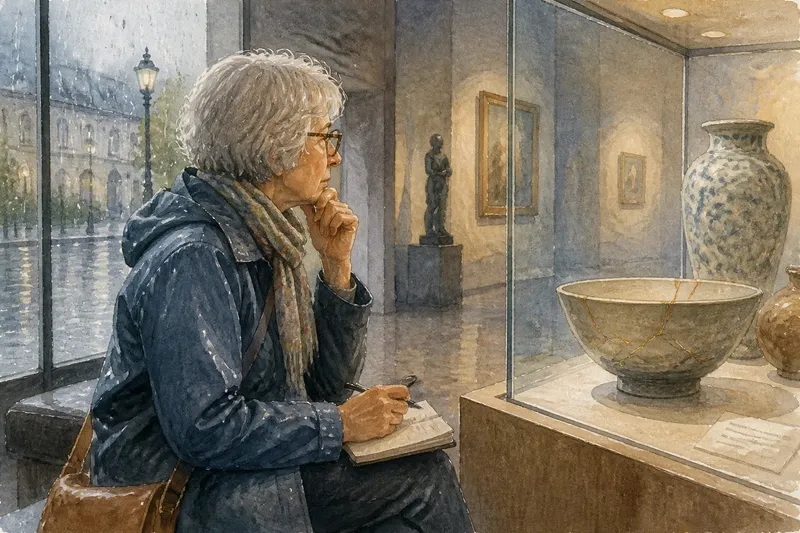
Say you arrive with a damp jacket and would rather not stand for long. The map shows a decorative-arts gallery near the entrance, with benches close by. You decide to notice which objects show signs of repair. In the gallery, a ceramic bowl has a visible line along its rim; you sit nearby and compare it with another object, but the second display offers no clear evidence of repair. You switch to looking at shapes, then leave after the room. The result is a focused visit, and the tradeoff is that you have not seen the rest of the museum.
Look without strain
Let your eyes do most of the work. Read a label when it answers a question you already have, then return your attention to the object. If small print is tiring, ask whether large-print materials, audio descriptions, or seating with a clearer view are available.
Photography rules vary by museum and gallery, so check signs before using your phone. A pocket notebook can be a quieter alternative: jot down a material, color, or detail rather than trying to record every room. If taking notes gets in the way of looking, put the notebook away.
When you are with someone else, compare observations rather than testing each other. One person might notice a painted border while another sees a repaired handle. If either of you needs a rest, pause at a bench or agree on a meeting point before exploring separately.
When should you change course?
What if the prompt does not fit the gallery?
Choose a detail that is visible in the room, such as a material, shape, or color. If nothing catches your attention, move to a nearby gallery or take a break.
Should you choose a prompt before arriving?
Start with a loose idea, then check the collection highlights and map. Adjust it to what is on view and how you feel that day.
What if your companion prefers another gallery?
Agree on a meeting place and a time to reconnect, or visit the separate galleries together if that suits both of you. Each person can bring back one detail to share.
How do you know when to leave?
Leave when you are ready, or pause and reassess if standing, noise, or concentration becomes uncomfortable. You do not need to reach a particular room for the visit to feel complete.
Keep one detail
Before leaving, name or jot down one thing you noticed: a repaired rim, a woven border, or the shape of a familiar tool. If you have a companion, share what drew your eye; if you are alone, a short note can help you recall the scene later.
For a rainy museum day, choose a prompt that fits the collection and a starting gallery that suits your comfort. The rainy museum day becomes easier to remember when you carry one concrete detail out with you, rather than a list of rooms you barely had time to see.